Tony Danza refuses an early goodbye shoot and breaks down in class
I'd Like to Apologize to Every Teacher I Ever HadTony Danza refuses an early goodbye shoot and breaks down in class is the decisive emotional reversal of the final week at Northeast High School. What begins as anger at a television production demand becomes a confrontation with the fact that the school year is ending and that he cannot treat his attachment to the students as scripted material. His refusal to perform farewell before the actual end of school gives way to tears, mutual affection, and a goodbye that the cameras capture only after it has become genuine.
Causes and Background
The episode occurs during the last week of school, when Tony Danza is already irritated by the pressure of Monday and by the uncertainty surrounding the television production. The camera crew must film the end of the year in case the network orders additional shows, including commencement on Friday. Leslie Grief also wants a classroom goodbye immediately, because most students will skip the final days. The proposed solution is to have Danza pretend to say goodbye before the school year has actually ended, reviving the very problem that has troubled the project throughout: the risk that television will manufacture emotion instead of recording it.
The request strikes a larger nerve because Danza’s life is divided between the school and the responsibilities he has left at home. After his talk show was canceled, he separated from his wife of twenty years, while only his youngest child remained at home in Los Angeles. He had begun teaching partly as a serious return to a road not taken, but the work has demanded more feeling and time than he expected. His elder daughter’s seemingly casual assurance that it was all right for him not to have bought a ticket home leaves him wondering whether he has already missed so much of her life that his presence no longer matters. In that context, the staged farewell is not merely an inconvenient production schedule; it threatens to turn a real separation into another piece of television before Danza has emotionally reached it.
The Refusal on Camera
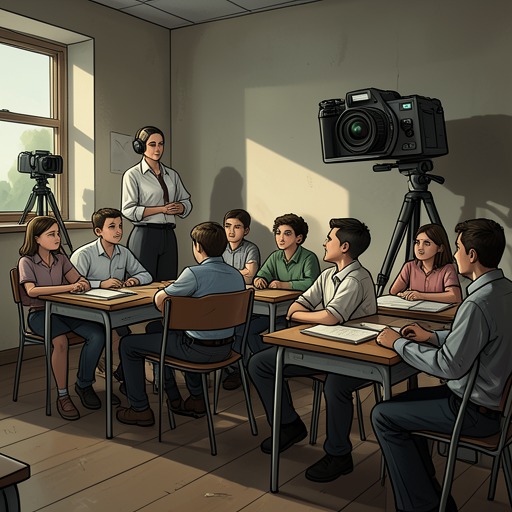
Danza arrives in an irritable mood, and the strain spreads through the room. As the crew sets up and attaches microphones, he directs his temper toward them and toward the students, whose usual rowdiness he finds especially difficult to tolerate. He even drags Eric Choi’s chair into the hall with Eric still in it. The gesture shows that his authority is functioning, but without its usual balance: classroom discipline has become an outlet for a feeling he has not yet understood.
The confrontation becomes explicit when Leslie Grief takes Danza aside and asks whether he is ready to shoot the goodbyes. Danza answers, "No," and insists that school is not over, that the class still has the entire week, and that he will not fake the farewell. When Leslie asks what the crew is there for, Danza replies, "I don’t know, and I don’t care." The exchange becomes a public family feud in front of the students. They watch with their mouths open, entertained by the conflict but uncertain which adult to support. Leslie leaves while the cameras continue rolling, turning Danza’s refusal into the very kind of unscripted drama the production might have been seeking.
Danza then returns to controlling the class rather than pursuing the argument. That choice is significant: he does not leave the students behind when the production relationship breaks down. Yet the return to routine cannot hold. Charmaine asks what is wrong with him, and two other students point out that school is nearly over. Danza begins to answer that he is going to miss them, but the sentence stops before he can finish it.
The Classroom Breakdown
The emotion arrives physically before Danza can organize it into an explanation. He breaks down in choking waves of sobs, with tears that are worse than before. The collapse reveals that his anger at the cameras has been a defensive surface over grief and attachment. He has been resisting not the existence of the goodbye but the demand to decide, on command and for the production, when the goodbye should begin.
His breakdown changes the room. The students rise from their seats and gather around him, including Al G, whose earlier disengagement had often been visible through yawns and indifference. Danza tells them how much he loves them, how much he will miss them, and how they have changed his life. They respond by patting his back and squeezing him tightly. Their physical closeness transforms the scene from a failed performance into a collective act of recognition: the teacher who has tried to manage the class is now being held by the class.
The students’ response also removes the anger that had dominated the morning. The camera crew receives its goodbye, but only after the planned version has been rejected and the real emotion has broken through. The scene’s irony is central to its meaning. Television has asked for a controlled imitation of departure; what it records instead is an uncontrolled acknowledgment that Danza cannot simply leave these students without consequence.
Consequences and Aftermath
The rest of the week is quieter and thinner. Only a handful of students attend class, and many of those present are not even Danza’s own students. The air-conditioning has failed again, leaving him largely resigned to talking with whoever appears. The depleted classroom makes the previous breakdown feel less like an isolated spectacle than a threshold: after the emotional truth has surfaced, the remaining days are marked by absence, waiting, and the approach of commencement.
Danza’s refusal also clarifies the conflict between his teaching identity and his media identity. He had entered Northeast as a public figure whose classroom was being filmed, and the production required usable scenes, continuity, and a goodbye at a convenient time. But his insistence that school was not over establishes a boundary around the students’ experience. He will not let the program declare the relationship finished merely because the cameras need a scene. His eventual tears do not erase that boundary; they demonstrate why it mattered.
The episode follows a longer pattern in Danza’s year. He has repeatedly discovered that teaching requires more than performance, technique, or goodwill. Lynn Dixon’s question about whether he will return next year prompts him to admit that, at his age, he is unsure whether he wants to care so much about anything. Her response—that this degree of caring is precisely what the work takes—echoes through the breakdown. The tears become evidence that he has crossed from visiting celebrity to invested teacher, even as that investment makes departure painful.
Narrative Significance
As a narrated event, the classroom breakdown turns the book’s central tension between reality and representation into a lived crisis. Danza is not simply documenting a goodbye; he is resisting the production’s attempt to schedule one, then discovering that the feeling cannot be controlled once the students confront him with it. The cameras remain present, but they no longer determine the emotional meaning of the scene.
The event also reverses the apparent direction of care. Danza began the morning trying to discipline students and contain the classroom, while the students seemed to be obstacles to filming. By the end, they are caring for the adult who has been caring for them. Charmaine’s blunt question, the students’ huddle, Al G’s presence, and the shared tears make the classroom a community rather than a backdrop.
The ending does not offer a simple resolution. Danza still has a wife and family in Los Angeles to return to, and he knows that teaching is exhausting. Yet when asked whether he will come back, he says he does not know even as he realizes that he does. The breakdown supplies the emotional answer before the decision is fully spoken: the school year can end, but the relationship has become too real to be dismissed as a temporary television experiment.